W. Edwards Deming was a pioneering statistician, educator, and consultant whose work revolutionized quality management and continuous improvement. Born in 1900 in Sioux City, Iowa, Deming’s contributions to industrial production, particularly in post-war Japan, helped shape modern business practices. His emphasis on data-driven decision-making, statistical process control, and leadership responsibility laid the foundation for Total Quality Management (TQM) and Lean Thinking. His most well-known framework, the Plan-Do-Check-Act (PDCA) cycle, remains a cornerstone of operational excellence.
Deming’s Key Theories and Contributions
1. Plan-Do-Check-Act (PDCA) Cycle
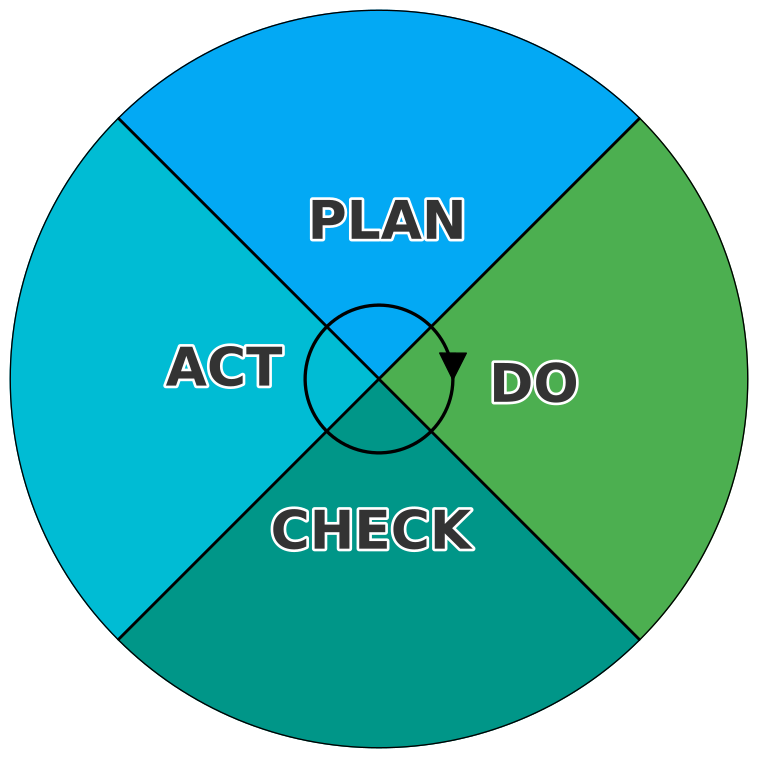
Deming refined the PDCA cycle, also known as the Deming Wheel, as a structured approach to continuous improvement:
- Plan – Identify a problem, set objectives, and develop a strategy.
- Do – Implement the plan on a small scale and collect data.
- Check – Analyze results and compare them to expectations.
- Act – Standardize successful changes and refine processes.
This iterative cycle ensures that businesses continuously improve operations, reduce inefficiencies, and enhance quality.
2. System of Profound Knowledge
Deming’s System of Profound Knowledge consists of four interrelated components:
- Appreciation for a system – Understanding how different parts of an organization interact.
- Knowledge of variation – Recognizing and managing variability in processes.
- Theory of knowledge – Emphasizing learning and adaptation.
- Psychology – Understanding human behavior and motivation.
This framework encourages leaders to take a holistic approach to management, focusing on long-term success rather than short-term gains.
3. Statistical Process Control (SPC)
Deming introduced SPC, a method for using statistical techniques to monitor and control processes. By analyzing data trends, businesses can identify inefficiencies and reduce defects, leading to higher consistency and reliability in production.
4. Leadership and Quality Management
Deming argued that quality is the responsibility of leadership, not just frontline workers. He emphasized employee empowerment, continuous learning, and eliminating fear in organizations. His 14 Points for Management provide a roadmap for fostering a culture of quality and innovation.
Achievements and Global Impact
- Revitalized Japan’s manufacturing industry post-WWII, leading to the rise of companies like Toyota.
- Developed the Deming Prize, awarded annually to organizations excelling in quality management.
- Influenced Six Sigma and Lean methodologies, shaping modern operational strategies.
Conclusion
Deming’s contributions extend beyond quality control, his philosophies transformed organizational leadership, strategic decision-making, and continuous improvement. His work remains essential for MBA students and business professionals seeking to drive sustainable success in competitive industries.