Key takeaway: The accounting cycle is the step by step process used to record, classify, and summarise financial transactions for each reporting period. It includes journal entries, posting to the ledger, preparing a trial balance, making adjustments, and producing financial statements. The cycle ends with closing entries that reset accounts for the next period.
The Accounting Cycle is the systematic process by which businesses record, analyze, and report financial transactions over a set period. It ensures financial statements accurately reflect a company’s financial position, helping managers, investors, and regulators make informed decisions.
This cycle follows a structured sequence, beginning with transaction identification and culminating in financial statement preparation. It operates within accrual accounting, ensuring revenues and expenses are recognized when incurred rather than when cash is exchanged.
Understanding the accounting cycle is crucial for corporate governance and strategic financial planning, linking to theories such as Agency Theory, Financial Transparency, and Internal Control Frameworks (COSO Model).
Stages of the Accounting Cycle
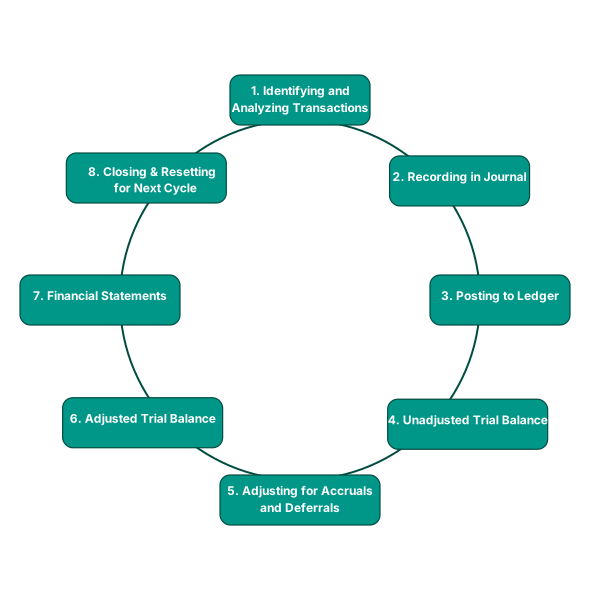
The accounting cycle consists of eight key steps, each ensuring financial accuracy and regulatory compliance:
1. Identifying and Analyzing Transactions
- Businesses record financial events, such as sales, purchases, and expenses.
- Transactions must align with GAAP (Generally Accepted Accounting Principles) or IFRS (International Financial Reporting Standards) for consistency.
2. Recording Transactions in Journal Entries
- Transactions are documented using double-entry bookkeeping, ensuring every debit has a corresponding credit.
- The accounting equation (Assets = Liabilities + Equity) remains balanced.
3. Posting to the General Ledger
- Journal entries are transferred to the General Ledger, summarizing all financial activities by account type.
- This step links to internal control theory, ensuring traceability and accuracy.
4. Preparing an Unadjusted Trial Balance
- The trial balance aggregates all ledger balances, ensuring total debits equal total credits.
- Discrepancies indicate errors requiring corrections before proceeding to financial statement preparation.
5. Adjusting Entries for Accruals and Deferrals
- Accrual Accounting mandates adjustments for revenues earned but not received and expenses incurred but unpaid.
- This step aligns with the Matching Principle, ensuring expenses correspond with related revenues.
6. Preparing an Adjusted Trial Balance
- After adjustments, businesses reevaluate account balances to confirm accuracy before financial reporting.
7. Preparing Financial Statements
- Businesses generate the income statement, balance sheet, and cash flow statement, presenting financial health to stakeholders.
- This step connects to Agency Theory, ensuring managers provide transparent reporting to shareholders.
8. Closing Temporary Accounts and Resetting for the Next Cycle
- Temporary accounts (revenues and expenses) are closed, resetting financial records for the next period.
- The process ensures continuity and financial consistency.
Link to Accounting & Business Theories
1. Agency Theory & Financial Transparency
- Financial reporting mitigates information asymmetry between managers and investors, ensuring accountability.
- Transparent financial cycles build investor trust, reducing principal-agent conflicts.
2. Internal Control & Fraud Prevention (COSO Model)
- The accounting cycle integrates internal control mechanisms, reducing the risk of financial misstatements or fraud.
- Businesses rely on compliance frameworks like Sarbanes-Oxley Act (SOX) to ensure ethical accounting practices.
3. Accrual Accounting & Matching Principle
- The accounting cycle ensures revenue and expenses align within correct periods, preventing financial distortions.
- Accrual-based reporting supports investment decisions, aligning with Efficient Market Hypothesis (EMH).
Example: How Businesses Apply the Accounting Cycle
Consider Nestlé, a global food company:
- Nestlé records millions of transactions, from ingredient sourcing to consumer sales.
- Transactions are logged in the General Ledger, ensuring traceability across subsidiaries.
- Adjusting entries reconcile revenues from long-term contracts, ensuring compliance with IFRS standards.
- Nestlé’s financial statements inform investors, aligning with Agency Theory by providing transparent corporate reporting.
By maintaining a structured accounting cycle, Nestlé ensures financial accuracy, regulatory compliance, and strategic oversight for global operations.
Conclusion
The Accounting Cycle is fundamental to corporate financial reporting, ensuring businesses accurately record, analyze, and present financial data. It connects to key theories, including Agency Theory, Internal Control Frameworks, and Accrual Accounting, shaping financial integrity and investment decisions.