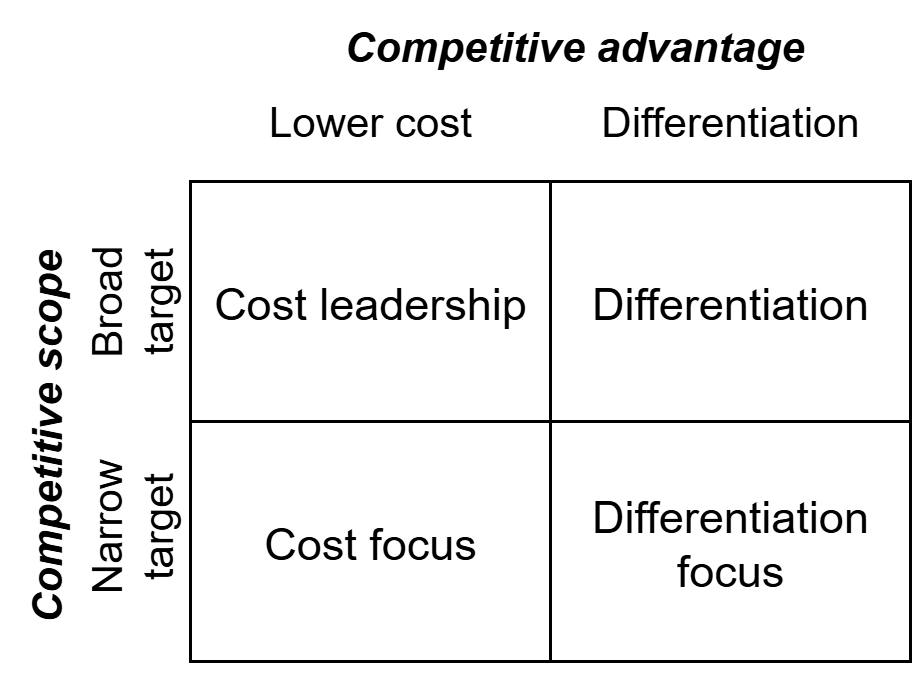
Proposed by Michael E. Porter in his seminal 1985 book “Competitive Advantage: Creating and Sustaining Superior Performance“, the Generic Strategies framework outlines how firms can achieve and defend a profitable position within their industry. Porter identified three core strategic options:
- Cost Leadership
- Differentiation
- Focus (which can be further divided into Cost Focus and Differentiation Focus)
Porter argues that to avoid being “stuck in the middle”, with no clear strategic direction, companies must choose one of these strategies to align their activities and build a coherent value proposition.
1. Cost Leadership Strategy
A firm pursues cost leadership by becoming the lowest-cost producer in its industry. This advantage can be passed on to customers via lower prices or retained to improve profit margins.
Key Characteristics
- Large economies of scale
- High operational efficiency
- Tight cost controls and standardized offerings
Related Theories
- Experience Curve (Boston Consulting Group): Costs decline with accumulated production experience.
- Lean Manufacturing & Six Sigma: Operational methodologies that reduce waste and variance to enhance cost performance.
Linkages
- Connects to Ansoff’s Market Penetration (low prices to gain share)
- Supports BCG Matrix strategies for “Cash Cows” to maintain volume and profitability
2. Differentiation Strategy
This strategy involves creating unique value for customers through innovative features, superior quality, branding, or customer service, allowing the firm to command premium prices.
Key Characteristics
- Strong brand identity
- Continuous innovation
- High customer loyalty
Related Theories
- Blue Ocean Strategy: Advocates for value innovation that makes competition irrelevant.
- Resource-Based View (RBV): Emphasizes leveraging firm-specific resources, brand, patents, capabilities, to sustain differentiation.
Linkages
- Aligns with the Product component of the Marketing Mix
- Tied to Brand Equity Theory and Customer Value Proposition
3. Focus Strategy
A firm using the focus strategy targets a specific market niche, tailoring offerings to suit the needs of a particular customer segment. This can be executed through either:
- Cost Focus: Offering lowest prices within a niche
- Differentiation Focus: Delivering uniquely tailored solutions to niche customers
Key Characteristics
- Deep understanding of customer needs
- Specialization
- Flexibility and customer intimacy
Related Theories
- Market Segmentation Theory: Understanding submarkets with distinct needs
- Long Tail Theory (Anderson, 2004): Profitably targeting small-volume niches in digital markets
Linkages
- Related to STP Model (Segmentation, Targeting, Positioning) in marketing
- Often combined with CRM systems for personalized engagement
Strategic Trade-offs and “Stuck in the Middle”
Porter cautions that trying to blend strategies, for instance, being both low-cost and highly differentiated, can lead to strategic incoherence, undermining the firm’s competitive advantage. However, modern perspectives (e.g., IKEA, Southwest Airlines) suggest that hybrid strategies may work under specific conditions if operationally aligned.
Example: How a Business Applies Porter’s Strategies
Let’s take IKEA as an illustration:
- Primary Strategy: Cost Leadership
- How: Flat-pack furniture, self-service warehouses, and lean supply chains minimize costs
- Differentiation Elements: Scandinavian design, sustainability, and in-store experience
- Focus Aspect: Targets value-conscious, design-savvy urban consumers
Despite blending cost and design, IKEA tightly aligns its operations with customer expectations, maintaining competitive clarity.