Michael E. Porter’s Diamond Model of National Advantage (1990) provides a framework for understanding why certain nations or regions develop competitive advantages in specific industries. Unlike traditional economic theories that attribute national competitiveness to natural resources or labor costs, Porter argues that competitive advantage is created, not inherited.
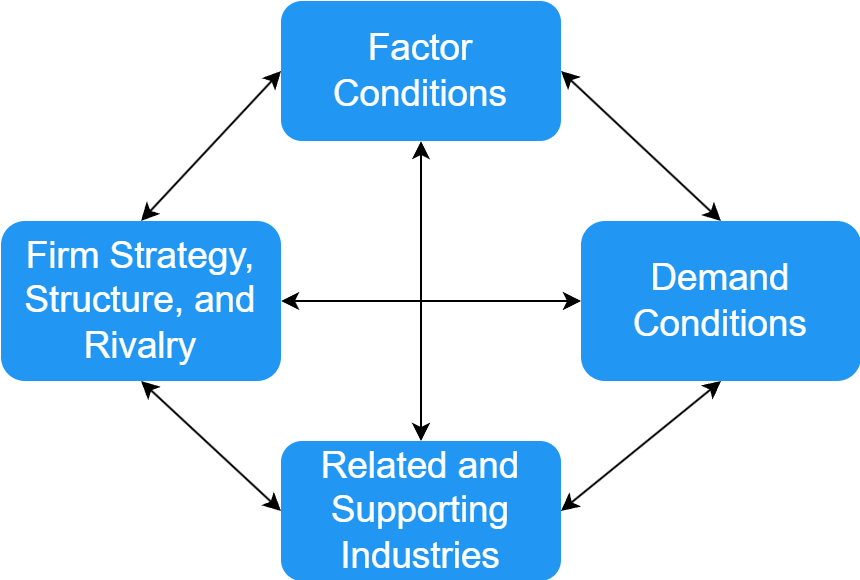
The model identifies four interrelated determinants that shape a nation’s ability to foster globally competitive industries:
- Factor Conditions – The availability and quality of resources
- Demand Conditions – The nature of domestic market demand
- Related and Supporting Industries – The presence of strong supplier networks
- Firm Strategy, Structure, and Rivalry – The intensity of domestic competition
Additionally, government policies and chance events influence these determinants, either reinforcing or weakening national competitive advantage.
Porter’s Diamond Model is particularly relevant for executives and policymakers seeking to understand global competitiveness, industry clusters, and strategic international expansion.
The Four Determinants of National Competitive Advantage
1. Factor Conditions – The Quality of National Resources
Factor conditions refer to a nation’s inputs that contribute to industrial success, including:
- Human capital (skills, education, managerial expertise)
- Infrastructure (transportation, digital connectivity, logistics)
- Technological capabilities (R&D investment, innovation ecosystems)
Porter distinguishes between basic factors (natural resources, climate) and advanced factors (specialized skills, research institutions). Nations that invest in advanced factors, such as Germany’s engineering expertise or Japan’s robotics innovation, develop sustainable competitive advantages.
Related Theories
- Resource-Based View (RBV) (Barney, 1991) – Competitive advantage stems from unique, valuable, and inimitable resources.
- Knowledge-Based Theory of the Firm – Intellectual capital and innovation drive long-term success.
2. Demand Conditions – The Role of Domestic Market Sophistication
Strong domestic demand pushes firms to innovate and refine their offerings, creating globally competitive industries. Nations with demanding consumers foster firms that develop superior products and services.
For example:
- Japan’s tech-savvy consumers drive innovation in electronics and automotive industries.
- The U.S. market’s high expectations for digital services fuel advancements in AI and cloud computing.
Related Theories
- Diffusion of Innovation (Rogers, 1962) – Early adopters in domestic markets accelerate industry growth.
- Customer-Driven Innovation – Firms respond to sophisticated consumer needs by developing cutting-edge solutions.
3. Related and Supporting Industries – The Strength of Industry Clusters
Competitive industries thrive when strong supplier networks and complementary industries exist within a nation. These clusters create knowledge spillovers, efficiency gains, and innovation synergies.
For example:
- Silicon Valley’s tech ecosystem benefits from proximity to venture capital, universities, and software firms.
- Italy’s fashion industry thrives due to specialized textile suppliers and design expertise.
Related Theories
- Cluster Theory (Porter, 1998) – Geographic concentration of interconnected firms enhances innovation and productivity.
- Network Theory – Strong inter-industry relationships improve resource access and strategic partnerships.
4. Firm Strategy, Structure, and Rivalry – Domestic Competition Drives Global Success
Intense domestic competition forces firms to continuously improve efficiency, innovation, and strategic positioning. Nations with high levels of intra-industry rivalry produce firms that are better equipped for global competition.
For example:
- Germany’s automotive industry (BMW, Mercedes, Volkswagen) thrives due to fierce domestic rivalry.
- South Korea’s electronics sector (Samsung vs. LG) drives rapid technological advancements.
Related Theories
- Competitive Strategy (Porter, 1985) – Firms must differentiate or achieve cost leadership to succeed.
- Game Theory – Competitive interactions shape strategic decision-making.
The Role of Government and Chance Events
While the four determinants form the core of Porter’s model, government policies and chance events also influence national competitiveness:
- Government Policies – Investments in education, infrastructure, and trade regulations can enhance or hinder industry growth.
- Chance Events – Technological breakthroughs, geopolitical shifts, or economic crises can reshape competitive landscapes.
For example, China’s government-driven investment in AI and semiconductor technology has accelerated its global competitiveness in advanced industries.
Strategic Linkages and Applications
Porter’s Diamond Model connects to several key strategic frameworks:
- Global Strategy (Bartlett & Ghoshal, 1989) – Firms must align international expansion with national competitive strengths.
- Institutional Theory – Regulatory environments shape industry competitiveness.
- Blue Ocean Strategy (Kim & Mauborgne, 2005) – Nations with strong innovation ecosystems create uncontested market spaces.
Example: How a Business Uses Porter’s Diamond Model
Finland’s Competitive Advantage in Mobile Technology (Nokia Case Study)
Nokia’s rise as a global leader in mobile technology was shaped by Finland’s strong national advantages:
- Factor Conditions: High investment in engineering and telecommunications research
- Demand Conditions: Early adoption of mobile technology by Finnish consumers
- Related Industries: Strong collaboration with software developers and telecom providers
- Firm Rivalry: Competitive domestic market drove continuous innovation
Despite Nokia’s decline, Finland remains a hub for 5G technology and digital innovation, demonstrating how national advantages evolve over time.
Conclusion
Porter’s Diamond Model provides a comprehensive framework for understanding national competitive advantage, emphasizing the role of resources, demand, industry clusters, and competition. For business leaders and policymakers, leveraging these insights enables strategic decision-making in global markets, industry positioning, and investment planning.