The normal distribution, also known as the Gaussian distribution, is one of the most fundamental concepts in statistics and business analytics. It describes a probability distribution where data points are symmetrically distributed around the mean, forming a bell-shaped curve. This distribution is widely observed in real-world business scenarios, including financial returns, customer behavior, and operational efficiency metrics.
The normal distribution is crucial because many statistical methods, including hypothesis testing, regression analysis, and predictive modeling, assume that data follows this pattern. Understanding its properties allows business professionals to make informed decisions based on probability and risk assessment.
Mathematical Representation
The probability density function (PDF) of a normal distribution is given by:
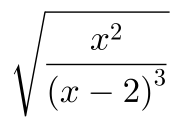
Where:
is the variable
is the mean (center of the distribution)
is the standard deviation (spread of the distribution)
is Euler’s number (~2.718)
is the mathematical constant (~3.1416)
This formula defines the likelihood of a given value occurring within the distribution.
Key Properties of Normal Distribution
- Symmetry: The distribution is perfectly symmetrical around the mean.
- Unimodal: It has a single peak at the mean.
- Mean, Median, and Mode Alignment: In a normal distribution, these three measures of central tendency are equal.
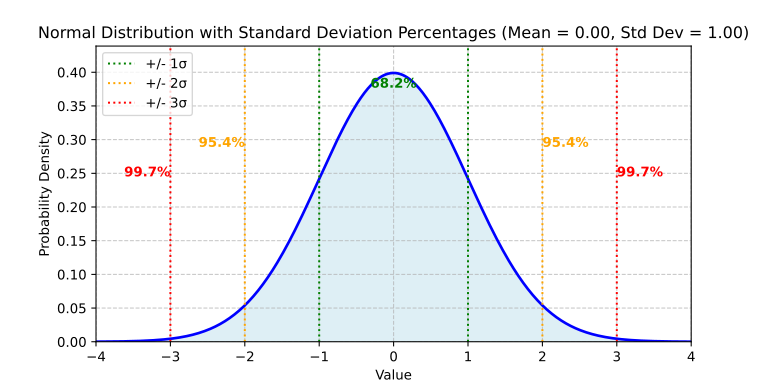
- Empirical Rule (68-95-99.7 Rule):
- 68% of data falls within one standard deviation of the mean.
- 95% falls within two standard deviations.
- 99.7% falls within three standard deviations.
These properties make the normal distribution a powerful tool for forecasting and decision-making.
Theoretical Connections
The normal distribution is closely linked to several statistical and business theories:
- Central Limit Theorem (CLT): The CLT states that the distribution of sample means approaches normality as sample size increases, even if the original population distribution is not normal. This principle underpins many business forecasting models.
- Risk Management & Portfolio Theory: Financial analysts assume stock returns follow a normal distribution when assessing volatility and risk exposure.
- Quality Control & Six Sigma: Manufacturing firms use normal distribution to monitor defect rates and optimize production efficiency.
- Behavioral Economics & Consumer Analytics: Customer purchase behavior often follows a normal distribution, allowing businesses to segment markets effectively.
Business Application Example
Consider Samsung, a global electronics manufacturer:
- Samsung analyzes smartphone battery life across different models.
- By plotting battery performance data, they observe a normal distribution, where most devices cluster around the average lifespan.
- Using the empirical rule, Samsung estimates the probability of extreme battery failures and adjusts warranty policies accordingly.
Through normal distribution analysis, Samsung enhances product reliability and customer satisfaction while optimizing operational costs.