Key takeaway: Mintzberg identified ten managerial roles grouped into interpersonal, informational, and decisional categories. Managers act as leaders, communicators, and problem‑solvers while allocating resources, handling disturbances, and representing the organisation. The framework shows that effective management requires balancing people skills, information processing, and strategic decision‑making in daily organisational life.
Henry Mintzberg, a Canadian academic and management scholar, challenged the traditional view of managers as planners and controllers by observing what managers actually do. In his seminal 1973 work The Nature of Managerial Work, Mintzberg identified ten distinct managerial roles, grouped into three categories: interpersonal, informational, and decisional. These roles reflect the multifaceted, dynamic, and often fragmented nature of managerial work.
Rather than viewing management as a linear process (as in classical theories), Mintzberg’s model emphasizes the behavioral reality of managers, how they interact, process information, and make decisions in real time. This framework remains highly relevant in today’s volatile, uncertain, complex, and ambiguous (VUCA) business environment.
The Three Categories and Ten Roles
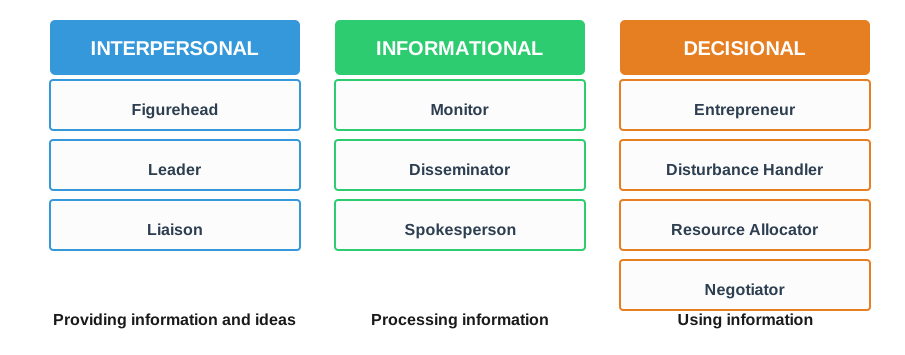
1. Interpersonal Roles – Building Relationships and Legitimacy
These roles involve interactions with others and are foundational to leadership presence and organizational influence.
- Figurehead: Symbolic duties such as attending ceremonies or signing legal documents. This role reinforces organizational legitimacy and culture.
- Leader: Motivating, coaching, and developing subordinates. This aligns with transformational leadership theory and emotional intelligence frameworks.
- Liaison: Networking with internal and external stakeholders. This role supports boundary-spanning and social capital development.
2. Informational Roles – Managing Knowledge and Communication
Managers act as conduits and filters of information, which is critical for strategic alignment and operational clarity.
- Monitor: Scanning the environment for relevant information. This role links to environmental scanning in strategic management and the concept of absorptive capacity.
- Disseminator: Sharing information internally to ensure informed decision-making.
- Spokesperson: Representing the organization externally, often in media or stakeholder engagements.
3. Decisional Roles – Driving Action and Resource Allocation
These roles reflect the manager’s responsibility for navigating complexity and making trade-offs.
- Entrepreneur: Initiating change and innovation. This role aligns with Schumpeterian innovation theory and intrapreneurship.
- Disturbance Handler: Resolving crises and unexpected challenges. This connects to crisis management and resilience theory.
- Resource Allocator: Distributing resources strategically, time, capital, talent.
- Negotiator: Representing the organization in negotiations, both internally and externally.
Theoretical Integration and Linkages
Mintzberg’s model complements and contrasts with several other management theories:
- Fayol’s Administrative Theory: Fayol outlined five functions of management (planning, organizing, commanding, coordinating, controlling). Mintzberg’s roles provide a behavioral lens to these functions, showing how they manifest in practice.
- Contingency Theory: While Mintzberg doesn’t prescribe a “best” way to manage, his roles suggest that effective managers must fluidly shift between roles depending on context, echoing the contingency perspective.
- Transformational Leadership: The leader role, in particular, aligns with transformational leadership, emphasizing vision, inspiration, and individualized consideration.
- Systems Theory: The informational and liaison roles reflect the manager’s function as a node in a broader organizational system, facilitating feedback loops and interdependence.
Common Misconceptions
Some people assume Mintzberg’s Managerial Roles describe a strict sequence of tasks, even though the roles represent interconnected behaviours that managers shift between throughout the day. Others believe the framework applies only to senior executives, when managers at all levels perform interpersonal, informational, and decisional roles. People also sometimes treat the roles as prescriptive instructions, yet Mintzberg intended them to help observers recognise the complexity and variety of real managerial work.
Practical Application Example
Case: Atlassian (Australia-based software company)
Atlassian’s team-based, agile culture provides a rich context for applying Mintzberg’s roles. For instance:
- Leader: Team leads at Atlassian are expected to coach rather than command, fostering autonomy and psychological safety.
- Monitor & Disseminator: Managers use tools like Confluence and Jira to track progress and share updates transparently across teams.
- Entrepreneur: The company’s “ShipIt Days” encourage managers and employees to experiment with new ideas, embodying the entrepreneurial role.
- Negotiator: In cross-functional product development, managers often negotiate priorities and resources between engineering, design, and marketing.
This example illustrates how Mintzberg’s roles are not theoretical abstractions but practical lenses through which managerial effectiveness can be understood and enhanced.