Chris Anderson introduced the Long Tail Theory in a 2004 Wired magazine article and later expanded it in his book The Long Tail: Why the Future of Business Is Selling Less of More. The theory challenges traditional notions of demand concentration by arguing that niche products collectively represent a substantial market opportunity, especially in digital environments where distribution and inventory constraints are minimal.
The “long tail” refers to the portion of a statistical distribution curve where a large number of items sell in small quantities, contrasting with the “head”, a small number of blockbuster products that sell in large volumes.
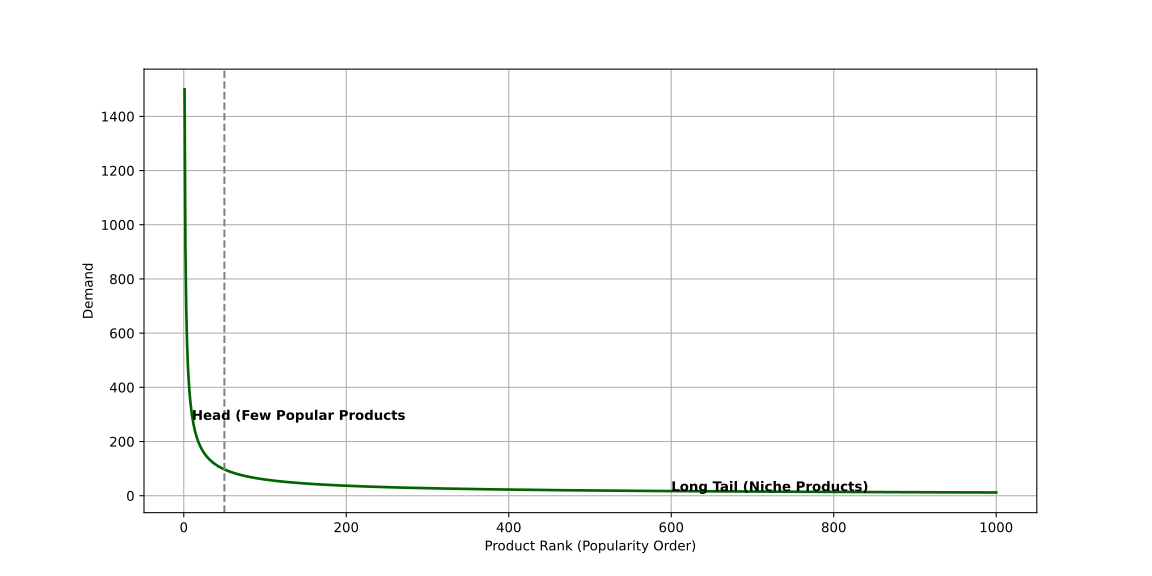
Core Principles of the Long Tail
- Shift from Hits to Niches: Traditional retail models focus on stocking high-demand products due to limited shelf space. Digital platforms, however, can offer vast inventories, enabling sales of niche items that individually have low demand but collectively generate significant revenue.
- Economics of Abundance:
- Low distribution costs: Digital platforms reduce the marginal cost of offering additional products.
- Search and recommendation engines: These tools help consumers discover niche products, increasing their visibility and accessibility.
- Demand Aggregation: The theory posits that aggregate demand for niche products can rival or exceed demand for mainstream hits, provided the distribution channel is sufficiently large and efficient.
Theoretical Linkages and Strategic Implications
- Pareto Principle (80/20 Rule): Traditionally, 80% of revenue comes from 20% of products. The Long Tail challenges this by suggesting that the remaining 80% of products (the tail) can be monetised effectively in digital contexts.
- Digital Disintermediation: Removing intermediaries allows producers to reach niche audiences directly, aligning with theories of platform economics and network effects.
- Mass Customisation and Consumer Choice Theory: The Long Tail supports the idea that consumers value variety and personalisation, reinforcing concepts from behavioural economics and marketing segmentation.
- Link to the Experience Curve: As firms accumulate experience in serving niche markets, they can reduce costs and improve targeting, creating a feedback loop that enhances profitability over time.
- Strategic Fit with Blue Ocean Strategy: By targeting underserved niches, firms can create uncontested market space, avoiding direct competition with dominant players.
Practical Application: A Business Example
Consider Netflix in its early evolution. While traditional video rental stores focused on stocking popular titles due to space constraints, Netflix leveraged its digital catalogue to offer thousands of niche films and documentaries. Over time:
- A significant portion of rentals came from the long tail of lesser-known titles.
- Recommendation algorithms helped users discover content aligned with their preferences.
- The strategy reduced reliance on blockbuster content and built customer loyalty through variety.
This approach allowed Netflix to differentiate itself, scale efficiently, and eventually disrupt the entire media distribution model.