Key takeaway: Data distribution shows how values are spread across a dataset, revealing patterns, extremes, and typical outcomes. Visualization tools, such as histograms, boxplots, and density charts, turn these patterns into clear visuals that support faster interpretation, better comparisons, and more confident business decisions in analytics and reporting.
Data distribution and visualization are critical components of business analytics, providing a structured way to interpret datasets and extract meaningful insights. Distribution describes how values are spread across a dataset, while visualization enables business leaders to recognize trends, patterns, and potential anomalies.
These techniques are fundamental in risk assessment, financial modeling, and strategic decision-making. Businesses rely on graphical representations to communicate complex data concisely, ensuring clarity in reporting and forecasting.
Common visualization tools include histograms, frequency distributions, box plots, and scatter plots, each serving distinct purposes in business applications.
1. Histograms & Frequency Distributions
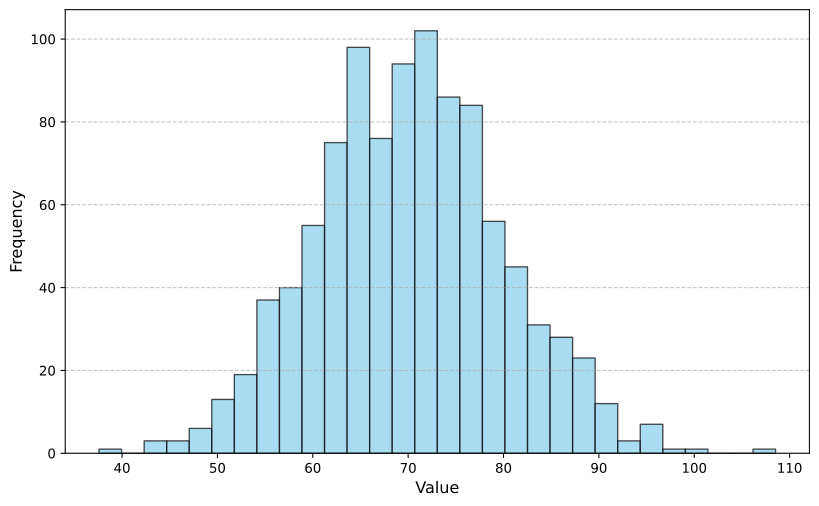
Histograms represent the distribution of numerical data by grouping values into bins and plotting their frequency. The formula for calculating frequency in a histogram is:
![[ \text{Frequency} = \frac{\text{Number of observations in bin}}{\text{Total observations}} ]](https://s0.wp.com/latex.php?latex=%5B+%5Ctext%7BFrequency%7D+%3D+%5Cfrac%7B%5Ctext%7BNumber+of+observations+in+bin%7D%7D%7B%5Ctext%7BTotal+observations%7D%7D+%5D&bg=ffffff&fg=000&s=0&c=20201002)
Frequency distributions provide tabulated representations of data to show how often different values occur.
Business Application:
Retail companies use histograms to analyze sales trends, identifying peak purchasing periods and customer spending behavior.
Theoretical Connection:
- Normal Distribution: Many business datasets approximate a normal curve in histograms, enabling predictive modeling.
- Central Limit Theorem (CLT): As sample sizes grow, the sample mean distribution stabilizes, making histogram-based forecasting more accurate.
2. Box Plots
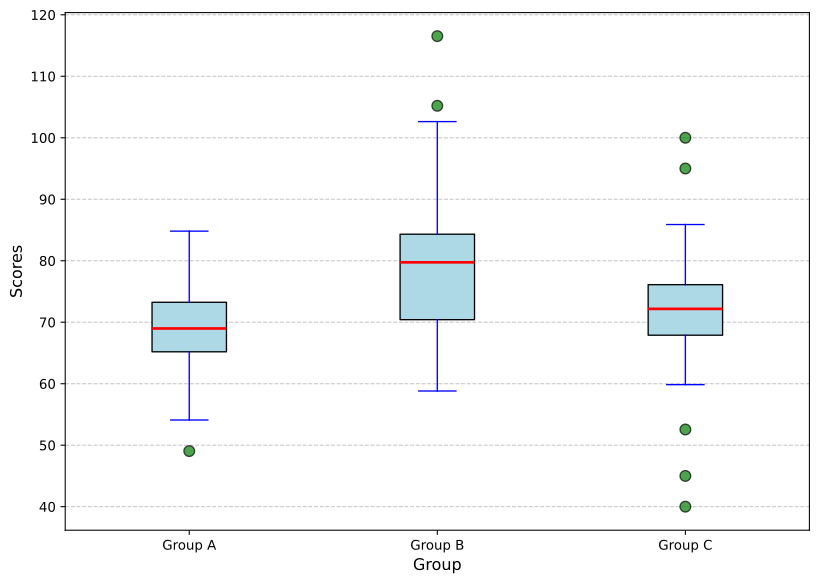
Box plots (also called box-and-whisker plots) summarize the spread and skewness of data using quartiles. The key formula components include:
- Interquartile Range (IQR):
- Whiskers: Extend to the minimum and maximum values within a calculated range.
- Median: The central horizontal line in the box.
![[ \text{IQR} = Q_3 - Q_1 ]](https://s0.wp.com/latex.php?latex=%5B+%5Ctext%7BIQR%7D+%3D+Q_3+-+Q_1+%5D&bg=ffffff&fg=000&s=0&c=20201002)
Business Application:
Financial analysts use box plots to assess investment volatility, identifying extreme values and outliers in stock price movements.
Theoretical Connection:
- Risk Management: Understanding price deviations helps mitigate financial risk.
- Behavioral Economics: Pricing psychology benefits from identifying consumer purchasing extremes.
3. Scatter Plots
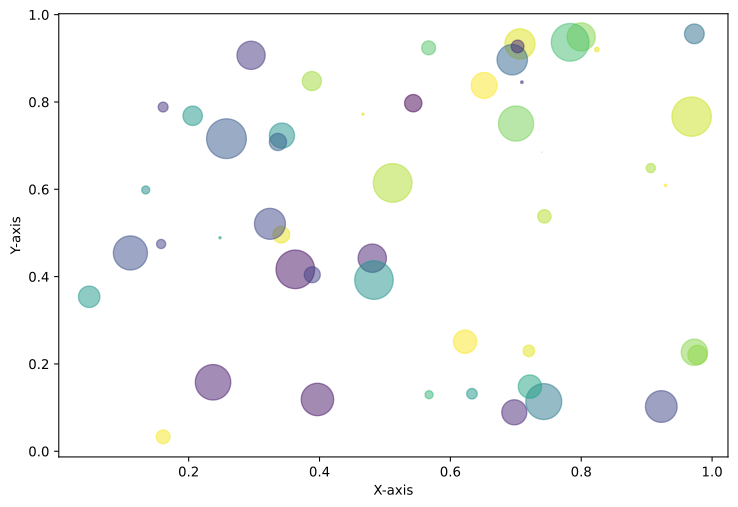
Scatter plots display relationships between two numerical variables. The equation for a simple linear relationship in a scatter plot is:
![[ y = mx + c ]](https://s0.wp.com/latex.php?latex=%5B+y+%3D+mx+%2B+c+%5D&bg=ffffff&fg=000&s=0&c=20201002)
Where:
is the dependent variable
is the independent variable
represents the slope
is the intercept
Business Application:
Marketing teams use scatter plots to analyze the correlation between advertising spend and sales revenue, optimizing campaign strategies.
Theoretical Connection:
- Regression Analysis: Scatter plots are foundational in predictive modeling.
- Data-Driven Strategy: Businesses refine pricing and resource allocation through scatter plot insights.
Business Application Example
Consider Marriott International, a global hospitality company leveraging data visualization in revenue management:
- Histograms analyze seasonal booking patterns, ensuring optimal pricing strategies.
- Box plots assess variations in customer satisfaction scores to target service improvements.
- Scatter plots compare promotional campaign investments with occupancy rates to maximize ROI.
Through strategic visualization, Marriott enhances revenue forecasting and operational efficiency.