Carroll’s Corporate Social Responsibility (CSR) Pyramid, developed by Archie B. Carroll, is one of the most widely recognized frameworks for understanding corporate responsibilities toward society. It categorizes CSR into four layers: economic, legal, ethical, and philanthropic responsibilities, illustrating how businesses balance profit-making with broader societal obligations.
Interest in ethics? Play the Trolley Problem and more …
The model is structured as a pyramid, emphasizing that businesses must first fulfill their economic and legal responsibilities before advancing to ethical and philanthropic commitments. This hierarchy reflects the practical reality that companies must remain financially viable while adhering to legal and ethical standards.
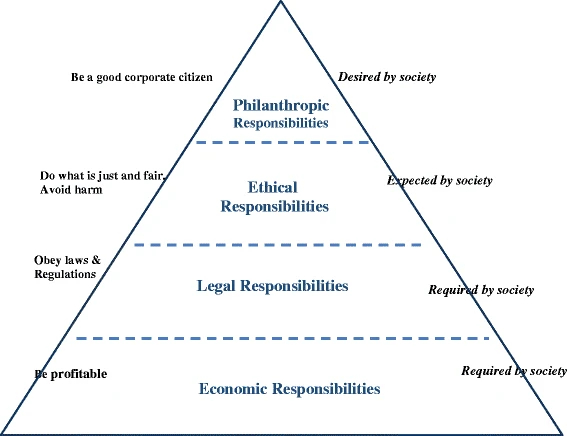
Image source
The Four Layers of Carroll’s CSR Pyramid
Economic Responsibility (Base of the Pyramid)
- The foundation of CSR, economic responsibility, refers to a company’s duty to be profitable and financially sustainable.
- Businesses must generate returns for shareholders, create jobs, and contribute to economic growth.
- This aligns with Milton Friedman’s shareholder theory, which argues that a company’s primary responsibility is to maximize profits.
Legal Responsibility
- Companies must comply with laws and regulations governing their operations.
- This includes labor laws, environmental regulations, and corporate governance standards.
- Legal responsibility connects to Social Contract Theory, where businesses operate within an implicit agreement with society to follow established rules.
Ethical Responsibility
- Beyond legal compliance, businesses are expected to act ethically, considering fairness, transparency, and moral obligations.
- Ethical responsibility aligns with Virtue Ethics, which emphasizes integrity and moral character in decision-making.
- It also connects to Stakeholder Theory, which argues that businesses should consider the interests of all stakeholders, not just shareholders.
Philanthropic Responsibility (Top of the Pyramid)
- The highest level of CSR involves voluntary contributions to social causes, such as charitable donations, community engagement, and sustainability initiatives.
- This aligns with Corporate Citizenship Theory, which views businesses as responsible members of society.
- While philanthropy is not mandatory, it enhances corporate reputation and strengthens stakeholder relationships.
Connections to Other CSR and Business Ethics Theories
Carroll’s CSR Pyramid integrates with several key business ethics frameworks:
- Triple Bottom Line (TBL) – Evaluates corporate success based on social, environmental, and financial performance.
- Shared Value Theory – Suggests that businesses can create economic value while addressing societal challenges.
- Integrative Social Contracts Theory (ISCT) – Balances global ethical principles with localized business norms.
These theories reinforce the idea that CSR is not just about compliance but about creating long-term value for both businesses and society.
Example: Carroll’s CSR Pyramid in Practice
A strong example of a company applying Carroll’s CSR Pyramid is Unilever, a multinational consumer goods company. Here’s how Unilever integrates CSR principles:
- Economic Responsibility – Ensures profitability through sustainable business practices.
- Legal Responsibility – Complies with environmental and labor laws across global markets.
- Ethical Responsibility – Implements fair trade policies and ethical sourcing.
- Philanthropic Responsibility – Invests in social initiatives, such as reducing plastic waste and promoting hygiene education.
Unilever’s approach demonstrates how businesses can balance financial success with ethical and social commitments.