The Ansoff Matrix, developed by Igor Ansoff in 1957, is a strategic planning tool that helps businesses identify and evaluate growth opportunities. It provides a structured approach for firms to expand their market presence by considering strategies for both existing and new markets and products.
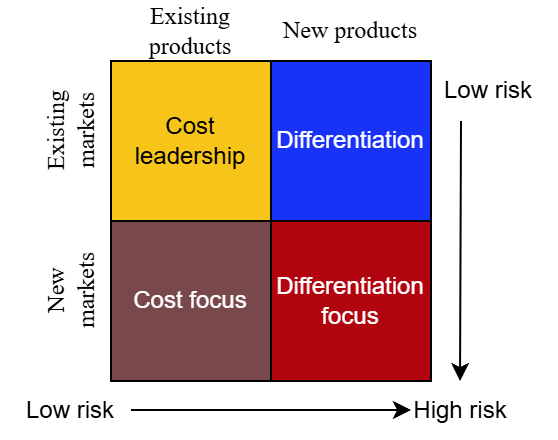
The matrix is particularly valuable for executives and business leaders seeking to align corporate strategy with market dynamics, assess risk levels associated with expansion, and determine the most effective path for sustainable growth.
The Four Growth Strategies of the Ansoff Matrix
1. Market Penetration (Existing Products, Existing Markets)
Market penetration focuses on increasing market share within existing markets using current products. This strategy is typically pursued through:
- Aggressive marketing campaigns to boost brand awareness
- Pricing strategies such as discounts or loyalty programs
- Expanding distribution channels to reach more customers
Related Theories
- Porter’s Generic Strategies (1980) – Market penetration aligns with cost leadership and differentiation strategies.
- Customer Lifetime Value (CLV) Model – Retaining existing customers enhances profitability.
Example:
Coca-Cola frequently employs market penetration by launching seasonal promotions and expanding its presence in convenience stores to increase consumption among existing customers.
2. Market Development (Existing Products, New Markets)
Market development involves expanding into new geographic regions or customer segments using existing products. This strategy is effective when:
- The firm identifies untapped customer segments
- There is potential for international expansion
- The product can be repositioned for different demographics
Related Theories
- Institutional Theory (North, 1990) – Firms must adapt to regulatory and cultural differences in new markets.
- Uppsala Model of Internationalization (Johanson & Vahlne, 1977) – Businesses expand gradually into foreign markets based on experiential learning.
Example:
Netflix expanded into international markets by adapting its content strategy to local preferences, investing in regional productions, and adjusting pricing models to fit different economies.
3. Product Development (New Products, Existing Markets)
Product development focuses on innovation and diversification within existing markets. This strategy is pursued through:
- R&D investment to create new offerings
- Brand extensions to leverage existing customer loyalty
- Technology integration to enhance product functionality
Related Theories
- Core Competency Theory (Prahalad & Hamel, 1990) – Firms leverage existing strengths to develop new products.
- Disruptive Innovation (Christensen, 1997) – Radical product development can reshape industries.
Example:
Apple continuously employs product development by launching new iterations of the iPhone, integrating advanced features such as AI-driven photography and augmented reality capabilities.
4. Diversification (New Products, New Markets)
Diversification is the highest-risk strategy, involving entry into new markets with new products. It can be categorized into:
- Related Diversification – Expanding into industries that complement existing capabilities (e.g., Amazon entering cloud computing).
- Unrelated Diversification – Entering entirely new industries (e.g., Virgin Group expanding into airlines, music, and finance).
Related Theories
- Resource-Based View (RBV) (Barney, 1991) – Firms with unique capabilities can diversify successfully.
- Conglomerate Theory – Large firms benefit from risk reduction through diversification.
Example:
Tesla diversified beyond electric vehicles into solar energy and battery storage, leveraging its expertise in sustainable technology to enter new markets.
Strategic Linkages and Applications
The Ansoff Matrix connects to several key strategic frameworks:
- BCG Matrix (Boston Consulting Group, 1970s) – Helps firms assess product portfolio performance.
- Blue Ocean Strategy (Kim & Mauborgne, 2005) – Diversification can create uncontested market spaces.
- Dynamic Capabilities (Teece, Pisano & Shuen, 1997) – Firms must continuously adapt their competencies to succeed in new markets.
Example: How a Business Uses the Ansoff Matrix
Starbucks’ Growth Strategy
Starbucks has successfully applied all four Ansoff Matrix strategies:
- Market Penetration: Expanding loyalty programs and mobile ordering to increase customer retention.
- Market Development: Entering new international markets, such as China and India.
- Product Development: Introducing new beverages, such as oat milk lattes and seasonal flavors.
- Diversification: Expanding into retail coffee products and partnerships with grocery chains.
By strategically leveraging the Ansoff Matrix, Starbucks has maintained global brand leadership while continuously adapting to market trends.
Conclusion
The Ansoff Matrix provides a structured approach for firms seeking growth opportunities while managing risk. By evaluating market penetration, market development, product development, and diversification, executives can make informed strategic decisions that align with their firm’s capabilities and market conditions.