Key takeaway: Maslow’s Hierarchy of Needs proposes that human motivation progresses through five levels: physiological, safety, love/belonging, esteem, and self‑actualisation. Individuals seek to satisfy lower‑level needs before pursuing higher ones. In business, the model helps managers understand employee motivation, design supportive workplaces, and improve engagement and performance.
Maslow’s Hierarchy of Needs, developed by Abraham Maslow in 1943, is a psychological framework that categorizes human needs into five levels, arranged in a pyramid structure. The theory suggests that individuals must satisfy lower-level needs before progressing to higher-level aspirations.
Maslow’s model is widely applied in business, marketing, leadership, and organizational behavior, helping firms understand employee motivation, consumer behavior, and strategic decision-making. It connects to theories such as Herzberg’s Two-Factor Theory, Self-Determination Theory, and Behavioral Economics, shaping how businesses design incentives and workplace environments.
The Five Levels of Maslow’s Hierarchy
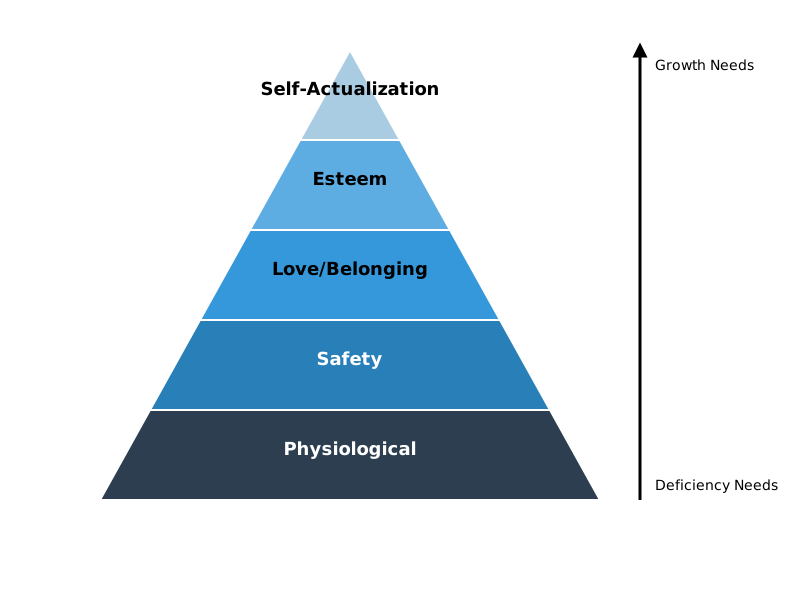
Maslow’s hierarchy consists of five sequential levels, each influencing human behavior and decision-making:
1. Physiological Needs – Basic Survival Requirements
- Includes food, water, shelter, sleep, and health.
- These needs are fundamental for human survival and must be met before higher-level motivations emerge.
Link to Theories:
- Behavioral Economics explains how scarcity of basic needs affects decision-making.
- McClelland’s Need Theory highlights how physiological security influences workplace motivation.
2. Safety Needs – Security and Stability
- Encompasses financial security, job stability, health protection, and personal safety.
- Employees seek stable work environments, while consumers prioritize brands that offer reliability.
Link to Theories:
- Herzberg’s Two-Factor Theory identifies job security as a hygiene factor influencing employee satisfaction.
- Risk Management Theory explains how businesses mitigate uncertainty to enhance consumer trust.
3. Social Needs – Belonging and Relationships
- Includes friendships, family connections, workplace culture, and social acceptance.
- Businesses foster engagement through team collaboration, brand communities, and customer loyalty programs.
Link to Theories:
- Social Identity Theory explains how individuals associate with brands and organizations.
- Emotional Intelligence Theory highlights the role of interpersonal relationships in leadership effectiveness.
4. Esteem Needs – Recognition and Achievement
- Encompasses self-respect, status, career success, and professional recognition.
- Employees seek promotions, while consumers value brands that enhance their social image.
Link to Theories:
- Self-Determination Theory emphasizes autonomy and competence as drivers of motivation.
- Equity Theory explores how perceived fairness in rewards influences employee engagement.
5. Self-Actualization – Personal Growth and Fulfillment
- Represents the pursuit of creativity, innovation, and purpose-driven work.
- Businesses encourage self-actualization through leadership development, innovation programs, and corporate social responsibility (CSR) initiatives.
Link to Theories:
- Transformational Leadership Theory fosters environments where employees achieve their full potential.
- Intrinsic Motivation Theory explains how purpose-driven work enhances productivity.
Example: How Businesses Apply Maslow’s Hierarchy
Consider Patagonia, the outdoor apparel company:
- Physiological Needs: Patagonia ensures fair wages and safe working conditions for employees.
- Safety Needs: The company promotes sustainability, reassuring consumers about its ethical sourcing practices.
- Social Needs: Patagonia fosters a strong brand community through environmental activism.
- Esteem Needs: Employees and customers align with Patagonia’s mission, enhancing brand prestige.
- Self-Actualization: The company encourages innovation and purpose-driven work, reinforcing its commitment to sustainability.
By integrating Maslow’s hierarchy, Patagonia enhances employee motivation, brand loyalty, and corporate responsibility, ensuring long-term success.
Conclusion
Maslow’s Hierarchy of Needs provides a structured approach to understanding human motivation, influencing workplace culture, consumer behavior, and leadership strategies. By linking to Herzberg’s Theory, Behavioral Economics, and Transformational Leadership, businesses optimize employee engagement, brand positioning, and strategic decision-making.