Key takeaway: The Marketing Mix describes the set of controllable tools a firm uses to shape customer value and drive demand. Traditionally defined by the 4Ps product, price, place, and promotion it helps managers design offerings, communicate effectively, and deliver value in a way that aligns with customer needs and competitive conditions.
Introduction to the Marketing Mix
The marketing mix is a foundational concept in marketing that helps businesses define and execute their marketing strategies. It consists of key elements that influence consumer decisions and organizational success. Originally developed as the 4Ps framework by E. Jerome McCarthy in 1960, the concept has evolved to encompass additional factors, such as the 7Ps for service-oriented industries.
The marketing mix ensures that businesses align their offerings with market demands while optimizing their approach to product positioning, pricing strategy, distribution channels, and promotional activities. By integrating marketing theories and models, organizations can refine their approach to creating customer value and sustaining competitive advantage.
The Four Pillars of the Marketing Mix (4Ps)
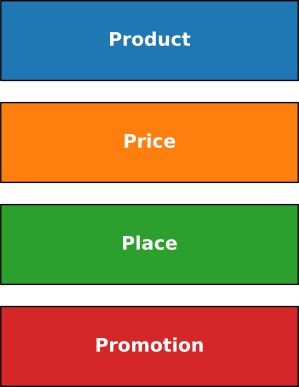
1. Product – The Core Offering
A product refers to anything offered to a market that satisfies customer needs or wants, whether a tangible good, intangible service, or even an experience. Products go through a lifecycle, necessitating different strategies at each stage.
Key Theories & Models Related to Product
- Product Life Cycle (PLC) Theory (Levitt, 1965): Introduces the stages of introduction, growth, maturity, and decline, guiding firms on adapting marketing strategies accordingly.
- Diffusion of Innovation Theory (Rogers, 1962): Explains how new products are adopted by consumers in stages, starting from innovators to laggards.
Connection to Other Theories
- Customer Value Proposition links to the product strategy by identifying unique selling points.
- Porter’s Generic Strategies (Cost Leadership, Differentiation, Focus) influences product positioning.
2. Price – The Revenue Driver
Price represents the amount a customer pays for a product or service. Pricing strategies influence customer perception, demand elasticity, and profitability.
Key Theories & Models Related to Price
- Price Elasticity of Demand (Marshall, 1890): Explores how price changes affect quantity demanded, guiding pricing strategies based on market sensitivity.
- Penetration Pricing vs. Skimming Pricing: Helps businesses decide between a low-price entry to gain market share or a high-price approach to maximize profits in early product adoption.
- Value-Based Pricing Model: Aligns price with perceived consumer value rather than cost.
Connection to Other Theories
- Behavioral Economics (Kahneman & Tversky, 1979) impacts pricing strategies by studying customer irrationality and decision-making biases.
- Game Theory applies to competitive pricing decisions.
3. Place – The Distribution Strategy
Place refers to how a company delivers its product or service to customers. Distribution channels, logistics, and accessibility determine market penetration.
Key Theories & Models Related to Place
- Channel Theory: Examines how different distribution models (direct vs. indirect) impact efficiency and customer reach.
- Omnichannel Strategy: Emphasizes seamless integration between online and offline sales channels to enhance the customer experience.
Connection to Other Theories
- Supply Chain Management influences place decisions, ensuring cost-effective and timely distribution.
- Network Theory connects businesses to logistics providers, suppliers, and digital marketplaces.
4. Promotion – Communicating Value
Promotion encompasses all marketing communications that persuade customers to engage with a product or brand, from advertising, public relations, sales promotions, and social media marketing.
Key Theories & Models Related to Promotion
- AIDA Model (Attention, Interest, Desire, Action): Guides the structure of effective advertising campaigns.
- Integrated Marketing Communications (IMC): Ensures consistency across different promotional channels.
- Hierarchy of Effects Model (Lavidge & Steiner, 1961): Explains customer engagement from awareness to purchase.
Connection to Other Theories
- Psychological Theories, such as the Elaboration Likelihood Model, influence how messages are processed.
- Brand Equity Theory explores long-term brand positioning strategies.
Expanding the Marketing Mix: The 7Ps
In services marketing, the 4Ps expand to 7Ps:
- People – Employees & customer service drive brand perception.
- Process – Service efficiency influences customer satisfaction.
- Physical Evidence – Tangible proof of service quality (e.g., branding, facilities).
These elements enhance customer experience management and relationship marketing.
Example of Marketing Mix Application
Case Study: Tesla’s Marketing Strategy
Tesla utilizes the marketing mix strategically:
- Product: Electric vehicles, innovative technology, sustainable focus.
- Price: Premium pricing reflecting brand value & technology.
- Place: Direct-to-consumer model via online orders & showrooms.
- Promotion: Digital marketing, word-of-mouth, influencer engagement.
By leveraging these principles, Tesla maintains strong brand equity and customer loyalty.